In 2015, a group of entrepreneurs in Copenhagen began working on a problem that restaurants, bakeries and supermarkets faced every day: perfectly edible food was being left unsold and discarded. Their solution was not another charity collection scheme or a campaign asking businesses to waste less. They set out to build a commercial marketplace where surplus food could be sold to customers at reduced prices.
The company became Too Good To Go.
The people behind the idea
The story began with Thomas Bjørn, who reportedly witnessed edible food being thrown away at the end of a buffet service in Copenhagen. The experience prompted him to consider whether technology could connect businesses with unsold food to people willing to buy it.
He contacted Stian Olesen and Klaus Bagge Pedersen, and the three began developing the idea. The company's official founders page identifies five original founders: Thomas Bjørn, Stian Olesen, Klaus Bagge Pedersen, Brian Christensen and Adam Sigbrand.
The company was established in 2015. A basic version of the service was developed before the end of that year, and the first meals were saved in Copenhagen in March 2016. The Danish marketplace app launched in early 2016.
The first version addressed a practical problem. Restaurants and food retailers could list surplus products, while customers could find nearby offers, reserve them and collect them during a specified time window. The company has not publicly identified the first individual customer or the first participating business, nor has it published a reliable itemised account of the original development costs or the founders' initial personal investment.
The surprise-bag model
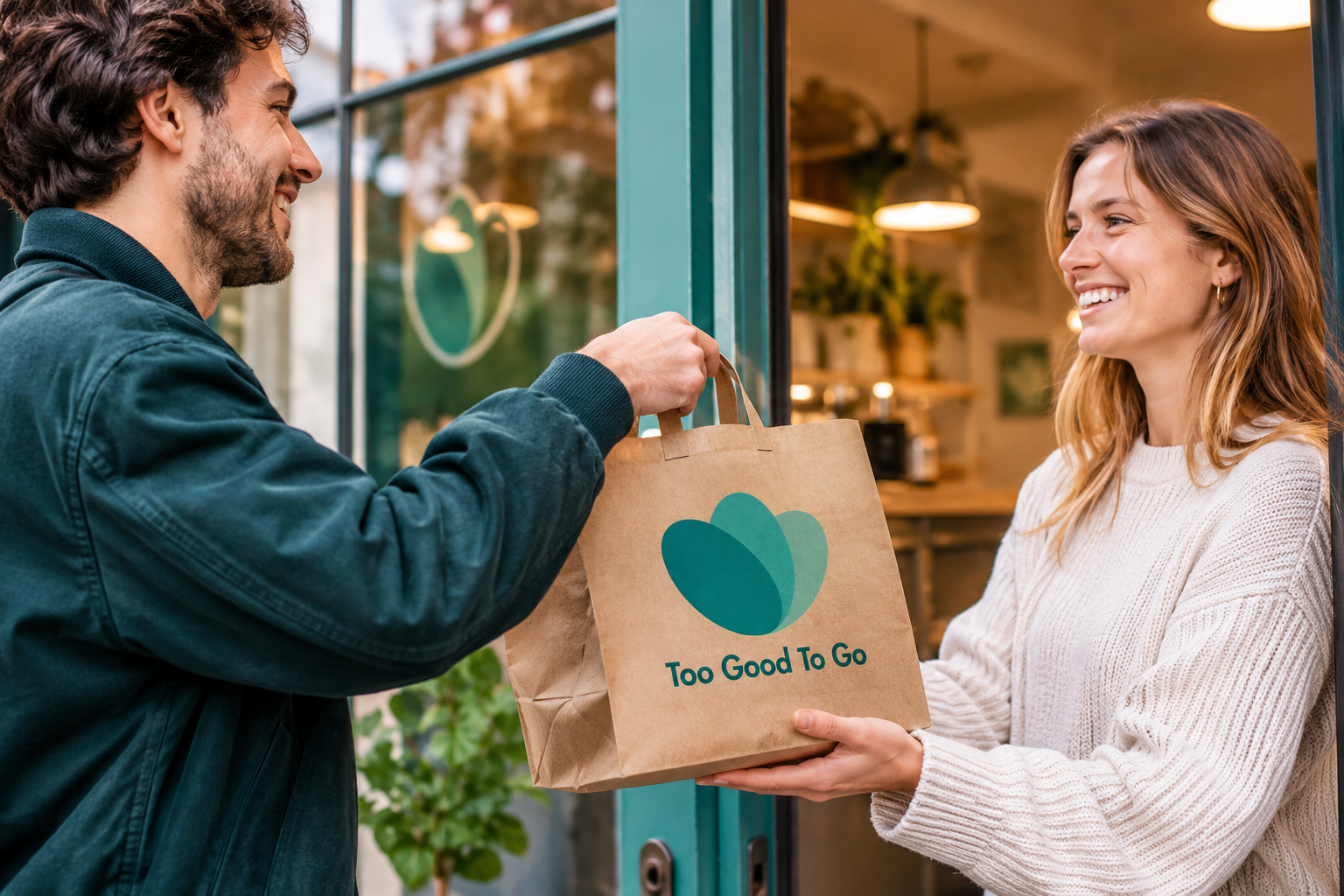
The central product was the Surprise Bag. Rather than requiring a business to predict exactly which items would remain unsold, the system allowed it to gather available surplus and sell it as a discounted package.
Customers could see the business, collection time and general type of offer, but the exact contents depended on what remained available that day. A bakery might have bread and pastries. A restaurant could have prepared meals. A supermarket might have groceries or other products approaching the end of their selling window.
This uncertainty was part of the model, not a flaw in it. The business did not have to create a separate menu of discounted items every evening. It could sell what was left, while customers accepted that the contents would vary.
The transaction also changed the economics of unsold stock. A product that might otherwise generate no revenue could still produce a sale. Customers received food at a lower price, and the business recovered some value from inventory it could no longer sell through its ordinary channels.
The platform earns money from transactions. In a 2021 report on the company's funding round, TechCrunch described Too Good To Go as charging a commission on sales. The company also offers partner services and commercial terms that vary by market and agreement.
For participating businesses, the attraction is not limited to the money recovered from a bag. Customers collecting an order enter the shop, discover the business and may purchase additional products. Too Good To Go has cited its own marketplace research indicating that 37% of surveyed customers bought additional items when collecting a Surprise Bag, while 61% said they had only visited the store because of the collection.
Building the first international teams
The Danish launch quickly attracted businesses and customers. According to the company's history, hundreds of businesses had joined and thousands of users were using the app within its first weeks.
Expansion began in 2016. Entrepreneurs in other European markets joined forces with the original team and established operations in Norway, the United Kingdom and France.
The British launch involved Christopher Wilson and Jamie Crummie, who had met while studying at the University of Leeds. Wilson encountered the Danish concept and approached the team. Crummie joined the effort, and the pair began recruiting businesses directly.
Their early work involved approaching restaurants and retailers and explaining why customers would want to buy food that had not sold during the day. The proposition wasn't immediately understood by everyone. Crummie later recalled that some people assumed the idea involved selling old or unsuitable food. The team had to explain that the products were still good to eat and that the service was designed around surplus, not spoiled food.
Jimmy Wu also became part of the British story. His sushi restaurant joined the scheme, and he subsequently joined the team. By October 2016, the London operation had reached 94 participating restaurants, according to contemporary reporting by the Evening Standard.
The French expansion brought in Lucie Basch, an engineer with experience in the food-processing industry. She joined the wider group of entrepreneurs working to develop the service internationally and helped establish its French operation, which launched in June 2016. Basch is an important figure in the company's international development, although the official list of the five original Danish founders is separate.
Mette Lykke enters the story
Another important development came through an unexpected encounter.
In September 2016, Mette Lykke, the Danish entrepreneur who had co-founded fitness platform Endomondo, heard about Too Good To Go from a woman sitting near her on a bus. Lykke contacted the founders, became an investor in October 2016 and took over as chief executive in spring 2017.
Her arrival brought experience from building and scaling a technology business. Endomondo had been acquired by Under Armour in 2015. At Too Good To Go, Lykke became central to the company's next stage of growth.
The business was no longer simply a Copenhagen project being copied into neighbouring markets. It was developing an international operating structure, recruiting local teams and building relationships with businesses in different countries.
Spain: a local competitor joins the network
Too Good To Go began operating in Spain in 2018. Its early Spanish team consisted of two people, according to a 2021 interview with the company's Spanish marketing director, Jonathan Zarzalejo.
There was already another business working in this market. Barcelona-based weSAVEeat had been operating since 2017, connecting customers with establishments selling surplus food in Barcelona and Madrid.
On September 3, 2019, Too Good To Go announced that it had acquired weSAVEeat. The deal brought the Spanish startup's participating establishments into the Danish company's network. At the time, weSAVEeat had more than 150 partner establishments, including Buenas Migas, Areas and Ametller Origen.
The acquisition was a practical expansion strategy. Instead of building every local relationship from scratch, Too Good To Go could incorporate an existing network of businesses and customers. The two services were consolidated under the Too Good To Go brand.
By September 2019, Too Good To Go had been operating in Spain for approximately a year. Contemporary reporting said its Spanish marketplace had already passed 500,000 users and 1,500 participating establishments. In February 2021, Zarzalejo reported that the Spanish team had grown to almost 100 employees and that the service had saved 2.5 million food packs in the country.
The money behind the expansion
For several years, the company expanded across Europe before raising a major venture-capital round.
In January 2021, Too Good To Go announced a $31.1 million funding round led by investment firm blisce/. The lead investor contributed $15.4 million, with existing investors and employees also participating. TechCrunch reported that this was the company's first funding round involving a venture-capital firm.
At that point, the business was operating in 15 countries, had approximately 30 million registered users and worked with around 65,000 businesses. It had reported saving 50 million meals.
The timing mattered. The COVID-19 pandemic had disrupted restaurants and other food businesses, and CEO Mette Lykke told TechCrunch that the company had experienced a substantial fall in revenue as restrictions affected its partners. The new capital supported further expansion, including its development in the United States.
The funding round also showed that the marketplace had become more than a small environmental initiative. It had a commercial model, a growing international customer base and a network of businesses large enough to attract institutional investment.
Beyond the original app
The company has since developed services beyond the original Surprise Bag marketplace.
Too Good To Go Parcels extends the model to food manufacturers and wholesalers. Instead of collecting unsold products from a local shop, customers can purchase parcels of surplus products sourced directly from manufacturers and have them delivered. The service addresses surplus created by changes in demand, packaging changes, damaged labels and other supply-chain circumstances.
The company has also worked on date-labeling education. Its Look-Smell-Taste initiative encourages consumers to distinguish between labels relating to product quality and those relating to food safety. The campaign focuses on the fact that some products marked with a Best Before date may remain suitable to eat after that date when correctly stored. It does not advise consumers to ignore Use By dates or food-safety instructions.
Another development is the use of data to improve the marketplace itself. In 2025, Too Good To Go introduced a Dynamic Pricing feature for partners. The system uses previous sales performance to adjust Surprise Bag prices at different points in the selling window. The company's stated aim is to improve the amount businesses recover from surplus while increasing the likelihood that bags are sold.
These developments show how the original marketplace has become a broader set of services for retailers, food producers and consumers.
What the business has become
Too Good To Go now reports operations in 20 countries, 150 million registered users, 200,000 active business partners and more than 500 million meals saved. These are company-reported figures.
The scale is significant, but the mechanism remains recognisable from its earliest version in Copenhagen: a business lists products it cannot sell through its usual channels, a customer reserves them at a reduced price, and the products are collected or delivered rather than discarded.
We've used Too Good To Go ourselves in Spain. The experience is straightforward: large bags of bakery products for a few euros. It's a practical example of the model from the customer's side, and one of the reasons the service is easy to understand once you've tried it.
What began with five named founders and a problem observed at a Copenhagen buffet has developed into a marketplace, an international network of local teams, a series of acquisitions, a venture-backed technology company and a collection of services reaching further up the food supply chain.
Sources & further reading
- Too Good To Go: Official company history
- Too Good To Go: The five original founders
- Copenhagen Business School: Research on the company's early development
- Tools of Change: Too Good To Go case study
- The Standard: UK launch and early team, October 2016
- Queen Mary University of London: Jamie Crummie profile
- Les Rencontres Économiques: Lucie Basch biography
- Fortune: Mette Lykke and Too Good To Go
- Too Good To Go: Acquisition of weSAVEeat, September 2019
- MarketingNews: Spanish operations and growth, February 2021
- TechCrunch: $31.1 million funding round, January 2021
- Too Good To Go: Dynamic Pricing, September 2025
- Too Good To Go: Press centre and company-reported figures
- Wikimedia Commons: Too Good To Go Copenhagen headquarters and licensing note